
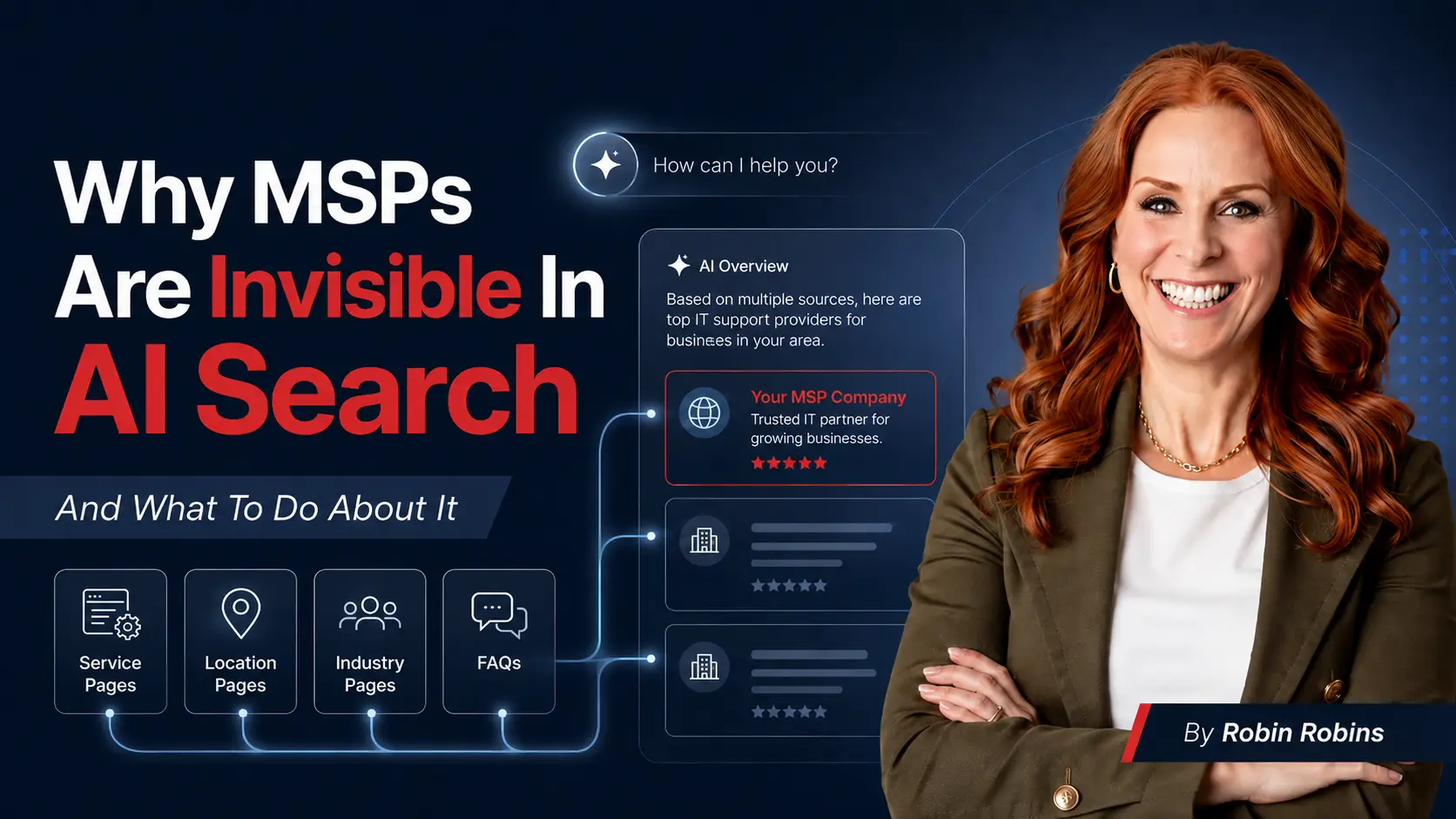
Answer engine optimization means structuring your content so it gets used as the direct answer inside AI-powered tools, rather than just ranking as a link. For MSPs the practical work is specific: build services, location and industry pages around the actual questions buyers ask, answer each one concisely right under the question, and add schema so engines can read the structure. This matters now because AI search weights right fit over proximity, so a vague generalist site gives the engine nothing to match on. Results vary with how competitive your niche is and how much content you already have.
AEO, or Answer Engine Optimization, has dramatically changed how MSPs drive inbound leads via search. Over the last two years, the transition from traditional SEO to AEO has rapidly accelerated due to a steep drop in traditional click-through rates and a massive shift in how corporate buyers research vendors.
The good news is that AEO leads are 4x to 20x more likely to convert because these are high-intent buyers.
Unlike traditional SEO, which focuses on ranking web pages in search results for you as a local MSP, AEO aims to have your content featured as direct answers within AI-powered tools.
That is a different job. Ranking gets you a link somebody might click. Being the answer means the engine reads your content, uses it, and names you. One requires you to be findable. The other requires you to be a good match.
Most MSP websites are neither.
What Changed About How Prospects Find MSPs Though Search
If you are familiar with how SEO works, you know that Google rewards MSPs who are local to the prospect searching for a new MSP with higher rankings. That requires you to have a physical location, not a PO box, to rank high in the Map Pack and organic results.
Now, with AI-generated search, findability is moving away from the traditional Google search that is heavily weighted on location (although that STILL is important) and is delivering recommendations focused on finding someone who is a right fit based on WHO the prospect is (type of company, technology used, size of the organization, etc.) and what they are looking for in a new MSP.
A prospect no longer types "IT support Nashville." They type something like this:
"We're a small accounting firm based in Nashville that uses QuickBooks and NetSuite ERP and needs a responsive IT firm that knows our business, can keep us compliant and can provide after-hours support."
Read that again and count how many matching criteria are in it. Location is one of six.
Take a minute right now and head over to ChatGPT or Grok and play prospect. Use a free account, not the one you use for everyday work so you get a truer result. Ask the AI who would be the best "IT company" for ________ (blank being the prospect you are looking to sell to and how they would possibly search) and see who it recommends.
What you will notice is that the results will mention local IT firms, but the MSPs recommended will also be based on whether or not they are a right fit than on simply being nearby.
If you are not in those results, the rest of this article is your fix.
Structure Your Service Pages Around Questions
When potential clients search for IT-related queries, they typically ask questions. "Who is the best IT services company for small businesses in Nashville?" or "What should outsourced IT support cost in Nashville?"
Because of this, you can give yourself an advantage with AEO by structuring your services pages around specific questions. Format content to answer queries like "What is managed IT services?" or "How does network monitoring work for small businesses?"
Include these questions in your headers and provide succinct answers directly below them, making it easy for AI tools to pick up your content.
That last part is where most MSPs fail. They will write a page containing the answer somewhere in paragraph four, buried in a wall of text about their proactive approach. An engine extracting a direct answer needs the question as a heading and the answer immediately underneath it, short enough to lift cleanly.
Then use schema markup, such as FAQ schema, to help search engines understand your page's context and feature it more prominently.
Rewrite Local Pages For "Conversational Queries"
To win in AEO, local pages need to stop sounding like they were written for a keyword spreadsheet and start sounding like answers to real customer questions. That's because prospects using AI to search for a new MSP input more information and have a conversation with AI about who the best IT company is for their specific needs.
Instead of repeating phrases like "IT support Nashville" throughout the page, build content around the way prospects actually ask: "Who provides IT support for dental practices in Nashville?" or, "How much does managed IT cost in Nashville?"
Then answer those questions immediately, in clear, specific language. This gives Google, AI Overviews, ChatGPT and other answer engines clean, quotable passages they can confidently surface. If you are unsure about what to write, think about the questions most prospects have when they initially call your office.
The key is to make every local page genuinely local and genuinely useful. Add short Q&A sections, location-specific proof, customer examples, service-area details, pricing context, common local problems and direct comparisons.
Also, use conversational headings like "How quickly can you get onsite?" or "What should a 25-person Nashville company expect to pay for IT support?" The goal isn't simply to rank for a city + service keyword anymore. It's to create the best, most direct answer to the questions a buyer in that city is already asking.
Build Industry-Specific Pages To Match What The AI Engine Is Matching On
If you have a handful of industries you're strong in serving (and want to continue to acquire clients in) then build web pages with clear, question-based content specific to that industry.
For example, if you target medical practice, you could have questions such as:
"How does an IT services company help medical practices become HIPAA compliant?"
"What cybersecurity solutions are best for financial services companies?"
"What IT services and functions should a construction company outsource?"
This approach positions your business as an expert in those fields, increasing your chances of being featured in AI-generated responses or industry-specific searches.
This is also where AEO and niching become the same conversation. An engine deciding which MSP fits an accounting firm running NetSuite needs a page that says you work with accounting firms running NetSuite. A generalist site offers nothing to match against. If you have not read it yet, the case for choosing a niche is here, and it is the prerequisite for everything on this page.
Talk About Who Your Services Are For
Your website and social media pages should clearly define the type of client you serve best. Do you work best with small businesses or enterprise accounts? Is it niche and industry focused, or based on employee count and revenue size?
Write articles and content on your website that detail the types of clients you work best with, the types of software you support, the services you deliver, and more descriptive copy detailing who your services are designed for.
Be detailed. Writing "we serve small and medium businesses" is too generic and broad. Name specific industries, locations, employee count, revenue range, platforms, technology and SaaS apps along with compliance and security frameworks.
That copy is what an AI engine reads when deciding whether to recommend you for a specific situation, and almost nobody in this industry has written it.
What To Do Today
Do these 4 things in the following order:
Find out who's being recommended now. Play prospect in the major LLMs (ChatGPT, Claude, Gemini, Perplexity and Grok) to see who is currently getting recommended for IT services for your target market. Make note of who you're consistently seeing. Visit their website and look at how they are structuring their content. Side Note: You could use tools like AnswerThePublic, Ahrefs and AlsoAsked if you want to spend a little money.
Pick your five questions. What are the top questions you get asked most on sales calls with new MSP prospects? Those questions become headers on your services pages, each with a short answer directly underneath.
Add the schema. Add an FAQ schema on services and industry pages and a LocalBusiness schema on location pages.
Write the "who we are for" copy. Industries, software, company size, compliance needs. Be specific enough that a machine could match a prospect to you. Add this to every industry page making it specific to the prospect you want in that industry. Add it to the home page of your site with a "Clients We Work Best With" and a description.
By implementing these strategies, your company can improve its search visibility and also establish itself as a go-to source for authoritative and trustworthy information.
If you want help working out which of these will move the needle fastest for your business, that is what my one-on-one consulting is for.
Frequently Asked Questions
What is answer engine optimization?
Answer engine optimization, or AEO, is the practice of structuring content so it gets used as the direct answer inside AI-powered tools, rather than simply ranking as a link in a list of results. Traditional SEO focuses on ranking web pages. AEO focuses on being the content an engine actually pulls from and cites. The techniques overlap, but the goal is different.
How is AEO different from SEO for an MSP?
SEO aims to get your page ranked so a prospect might click it. AEO aims to have your content featured as the answer inside AI tools, chat assistants and voice search. Practically, AEO means question-based headers with concise answers directly beneath them, schema markup so engines can read your structure, and explicit content about who you serve rather than general claims.
How do I get my MSP found in AI search?
Structure your services, location and industry pages around the questions your buyers actually ask, and answer each one concisely right below the question. Add FAQ schema and LocalBusiness schema. Then write detailed copy stating the industries you serve, the software you support and the compliance needs you handle. AI search matches on right fit, so specificity is what makes you findable.
Does location still matter for MSP search?
Yes, but less than it used to. Google's traditional search weights location heavily and requires a physical address to rank in the Map Pack. AI-generated search is moving toward right-fit matching based on who the prospect is and what they need, so location becomes one criterion among several. Keep your NAP visible and your local pages strong, but stop relying on proximity alone.
What schema should an MSP website use?
At minimum, FAQ schema on services and industry pages so engines can identify question-and-answer pairs, and LocalBusiness schema on location pages with your name, address and phone number. Schema does not make weak content rank, but it makes good content readable to machines, which is the entire point of AEO.
How do I know if my MSP is showing up in AI search?
Test it yourself. Open ChatGPT, Grok or your favorite AI tool. Describe your ideal client's exact situation and problems as they would when searching for a new IT company. Include industry, software being used and other requirements relevant to your target audience. See which providers get recommended and note how the AI is classifying your MSP (if at all). If you are not among them, note who is and look at what their website says about who they serve. That gap is your content plan.